Tankless units are sophisticated machines, and that is both their strength and their weak spot. Instead of keeping forty or fifty gallons hot around the clock, a tankless heater comes to life only when water starts moving: a flow sensor detects demand, the control board fires the burner or elements, and water is heated on its way through the heat exchanger. Every step is watched by a sensor, and if any reading drifts outside its expected range, the board shuts the heater off and displays a code. For Corvallis, OR homeowners, that usually traces back to a short list of causes: scale building up inside the heat exchanger, a sticking or dirty flow sensor, an ignition problem at the igniter or flame rod, or a venting or gas supply issue the unit reads as unsafe.
Error codes are a starting point, not a verdict, and we treat them that way on every Corvallis call. The same ignition failure code can come from a worn igniter, a fouled flame rod, a gas line too small to feed the burner at full fire, or an air intake clogged with lint. That is why Corvallis Water Heater tests before replacing anything. Our technicians read the fault history stored in the control board, watch flow sensor output with a faucet open, measure flame signal and igniter resistance, and put a manometer on the gas inlet to see what pressure actually reaches the valve when the burner is running flat out. We also compare inlet and outlet temperatures against the flow rate, which exposes a scaled heat exchanger long before it fails outright.
We work on tankless heaters from Rinnai, Navien, Noritz, Rheem, Takagi, and the other major brands, gas-fired and electric alike. The fix depends on the diagnosis: a full descaling flush through the isolation valves when scale is choking the heat exchanger, a new flow sensor when the unit no longer notices a faucet opening, a fresh igniter or cleaned flame rod when ignition keeps failing, or a vent correction when the unit trips on combustion air. Sometimes the answer is bigger. A gas line undersized for the unit's full firing rate has to be upsized, and a heat exchanger cracked by years of scale may make replacement the smarter call on an older unit. Either way, you get the facts before you spend a dollar. Call (541) 641-4520 to schedule tankless repair.
What homeowners call us about most is Water Heater Repair in Corvallis. Either is a good place to start.
Symptoms That Mean It's Time to Call
Water heaters usually give plenty of warning before they fail, as long as you know what to look and listen for. These are the red flags our technicians see most often before a breakdown:
- A clicking igniter with no flame, or a flame that lights and quickly drops out
- A combustion fan that sounds louder or rougher than normal
- A cold-water sandwich that has gotten noticeably worse
- Outlet temperature that surges and sags while water is running
- An error code flashing on the unit's display
- Moisture, rust, or drips appearing below the heater
- Hot water that cannot keep up with more than one fixture
- No hot water at a low-flow faucet even though the shower works fine
Act Before It Gets Worse
Left alone, even minor symptoms like rumbling or temperatures that swing from hot to warm tend to mean the heater is working its way toward a breakdown. At the first hint of a problem, reach out to Corvallis Water Heater at (541) 641-4520 and we'll take a look.
Get Tankless Water Heater Repair Handled Today
Call our team for pricing today.
Tap to Call (541) 641-4520Tankless Water Heater Repair FAQ
Why Professional Tankless Water Heater Repair Matters
Start with what is at stake. A gas-fired tankless heater can burn nearly 200,000 BTU per hour at full fire, and its vent is the only thing carrying carbon monoxide out of the house; a joint that pulls loose or an intake that gets blocked changes that in a hurry. On the electric side, the loads are large, frequently more than 100 amps spread over several 240-volt circuits. Then there is the diagnostic puzzle. Error codes point to a system, not a part, so a flow sensor fault, a scaled heat exchanger, and a bad thermistor can look nearly identical on the display, and guessing gets expensive.
Professional service is usually the cheaper path, too. Our technicians do not guess at error codes. They test flow sensors with water moving, measure flame rod signal, confirm igniter resistance, read inlet gas pressure at full fire, and check the vent from end to end. When scale is the problem, we flush it out properly and rinse the system before the unit goes back in service. And because some tankless problems, like an undersized gas line or a cracked heat exchanger, are not solved by parts at all, we tell you so directly, before you commit to anything.
From Your Call to Hot Water
Good water heater work comes down to a consistent routine, and ours starts with a real diagnosis instead of a guess. Here's a look at each step our team takes:
Code & Fault History Review
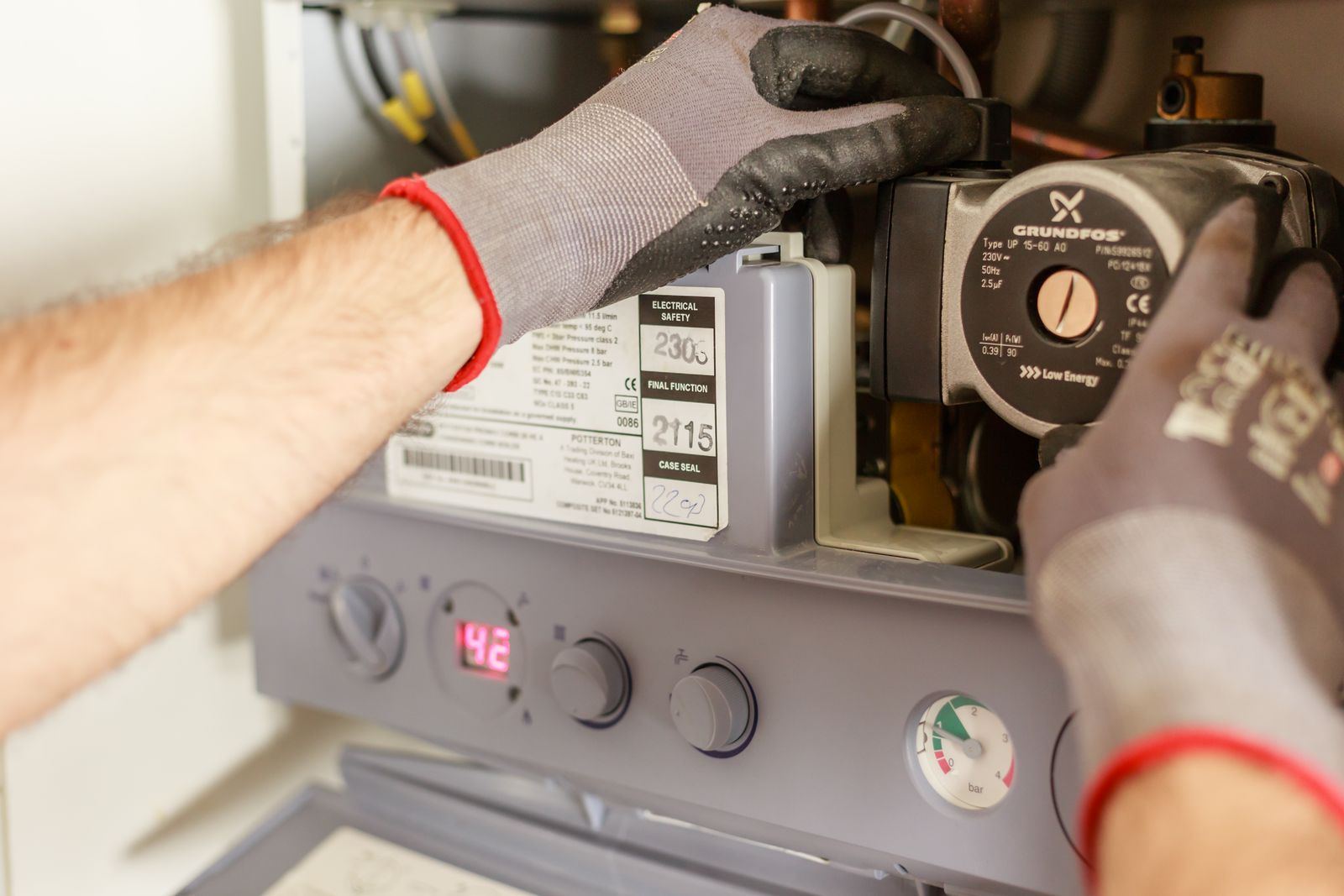
The control board is our first stop. We read the current code and past faults, then confirm the diagnosis with a meter and a manometer on the flow sensor, ignition parts, gas supply, and vent.
What We Found & What It Costs
Nothing is hidden. We walk you through the cause and the fix and give you the price up front. If the real problem is an undersized gas line or a worn-out heat exchanger, you will know before anything is spent.
Same-Visit Fix
Because common parts ride along, the repair rarely waits. Scale is flushed out through the service valves, and worn sensors or ignition parts are swapped during the same visit.
Full Performance Test
We never assume a fix worked. We test the unit at low flow and at full demand, confirm a steady outlet temperature, and verify that the code is cleared and stays cleared.
Repair or Replace? Let's Figure It Out.
Our technicians can assess your water heater and recommend the option that actually makes sense.
Get Help: (541) 641-4520Simple Ways to Extend Your Water Heater's Life
A little routine care goes a long way toward keeping a water heater running well past its expected lifespan. Follow these tips from our technicians:
- Consider a water softener or scale-reduction filter ahead of the heater if scale keeps returning
- Keep the vent termination and air intake clear of leaves, nests, snow, and lint
- Rinse the small filter screen on the cold inlet every few months
- Write down any error code before resetting the unit, and call if it keeps coming back
- Have the gas line evaluated whenever you add a range, dryer, or fireplace
- Schedule a descaling flush every year; hard water may call for one every six months
- Never cut power to an outdoor or garage unit in winter, because it needs electricity to protect itself from freezing
DIY vs. Professional Tankless Water Heater Repair
A few tasks, like checking the temperature setting or lifting the relief valve lever to test it, are fine for homeowners, but most water heater work involves gas lines, venting, 240-volt circuits, or a tank full of scalding water, and that belongs with a professional. Consider the following comparison:
| Factor | DIY Attempt | Hiring a Pro |
|---|---|---|
| Reading the Code | Look up the code and replace a guess | Each suspect part tested with a meter |
| Scale Removal | Partial flush that leaves scale behind | Proper solution, pump, and flush time |
| Combustion Safety | No way to test pressure at full fire | Gas pressure and vent run verified |
| Board & Wiring | Exposed wiring and sensitive electronics | Wiring and connectors tested safely |
| Parts | Wrong sensor ordered on a guess | Correct part for the exact model |
| Result | Code returns within weeks | Unit tested at low and high flow |
Let's Get Your Hot Water Back
Get your hot water back before a small fault turns into a flooded floor. Corvallis Water Heater is ready to respond fast.
Call (541) 641-4520 TodayTankless Water Heater Repair Across the Corvallis Area
Our technicians handle tankless water heater repair throughout Corvallis and the surrounding communities, with the same upfront pricing everywhere we work.